• Skip to primary navigation
  • Skip to main content
  • Skip to primary sidebar
  • Skip to footer
RevUp Dental

RevUp Dental

Drive More Patients To Your Practice With Our Patients Generating Dental Platform.

  • Solutions
    • Dental Website DesignBook more patients with our dental websites.
    • Google Ads for DentistsGet more new patients with google ads campaigns for dentists.
    • Dental SEOData-driven dental SEO that brings new patients.
    • Dental Staff TrainingTake your customer service and booking success to the next level.
    • ScorecardRun a smarter, more profitable dental practice.
  • Resources
    • Dental Marketing LibraryExplore our collection of articles focused on the latest trends and best practices in dental marketing.
    • Free eBooksOur free, comprehensive guides for in-depth knowledge and practical strategies to get more patients.
    • Video HubWatch our video tutorials designed to enhance your dental marketing strategies and skills.
    • WebinarsParticipate in our webinars for hands-on training and live feedback.
    • Dental Staff TrainingTake your customer service and booking success to the next level.
  • Testimonials
  • About
  • Login
  • Request a demo

Dental SEO

Improving Your Dental Website Ranking on Google

revupmanager Filed Under: Dental SEO May 6, 2022

Improving Your Dental Website Ranking on Google

Key Takeaways

  • Ranking higher on Google is no longer about technical tricks or keyword stuffing. It is about creating pages that genuinely answer the questions patients are searching for.
  • Tools like AnswerThePublic show you exactly what potential patients want to know about procedures like Invisalign or implants. Use those questions to shape your content, not guesswork.
  • A single, well-organized landing page that answers 20 common questions will outperform 20 separate blog posts covering the same topics with less depth.
  • A page that just says "We do Invisalign, call us!" does not work anymore. Patients want to understand 80 to 90 percent of what they need to know before they ever pick up the phone.
  • Writing more content is not the goal. Writing better, more useful content on fewer pages is what moves rankings and builds trust with patients.

We’re going to dive into on-page optimization—how to adjust your website’s content to rank higher for the keywords your potential patients are searching for. If you haven’t seen our previous video on Keyword Research, start there. For those who have, you’ve done your research and chosen some great keywords. Now, let’s discuss how to make your dental website perform better for those keywords.

On-page optimization is likely the part of the SEO process that most dentists are familiar with—things like adjusting title tags, optimizing meta descriptions, and adding the right keywords to the page. However, this aspect of SEO is also surrounded by a lot of misconceptions. We often see dentists and even the marketing companies they’ve hired, using on-page dental SEO strategies that stopped being effective years ago. So, let’s begin by addressing some of these misconceptions to help you avoid wasting time and money on outdated tactics that won’t improve your rankings.

Well written content is key

Many dentists believe that “Google likes content,” so they focus on writing a lot of content, like blog posts, thinking this will help them rank better. While it’s true that Google values content, it’s looking for well-written, informative, and genuinely useful content. If you’re simply churning out content for the sake of having more pages—like many dentists do—with blog posts that cover a lot of topics superficially, it won’t improve your rankings. In fact, it might not help at all.

Another common misconception is that ranking better is all about “putting the right keywords on the page.” While keywords are important, it’s not the whole story. Google’s algorithms are advanced enough to understand that your website is a dental practice and that your Invisalign page is discussing Invisalign, even if you don’t mention the keyword 50 times. Overstuffing your content with keywords can actually hurt your rankings, making your page appear unnatural and less user-friendly to both Google and potential patients. Instead, focusing on providing high-quality, relevant information is what will truly set you apart.

Answer the public

On-page SEO used to be about tricks and technical hacks that could fool the search algorithm into thinking your page was more relevant than a competitor’s. But today, achieving better rankings is less about tweaking technical details and more about creating high-quality, engaging content. Let’s explore how you can do this effectively:

For example, if you want to attract more Invisalign patients, you need a high-quality, value-driven landing page dedicated to Invisalign. The key is to create a page that answers the questions people are typing into Google when they’re researching Invisalign. There’s a fantastic tool for this called Answer the Public.

Simply visit www.answerthepublic.com, type in a dental service like “Invisalign”, and the tool will display a list of common questions people are searching for related to that topic. Let’s walk through some examples and think about the kind of content that would best address these questions.

Example Question: Why is Invisalign better than braces?
This is a great topic to cover on your website. You could write a detailed paragraph explaining the differences between Invisalign and traditional braces, include a pros and cons list, or create a video that visually compares the two options. This kind of content provides clarity and value to your readers.

Example Question: What does Invisalign look like on teeth?
For this question, you could take photos of a patient with and without Invisalign trays to show how discreet the aligners are. A visual demonstration can reassure potential patients about the appearance of Invisalign.

Here are a few more valuable questions people are asking:

  • Can Invisalign fix overbite?
  • Can Invisalign fix underbite?
  • Does Invisalign give you a lisp?
  • What insurance covers Invisalign?

These are all great questions—real, practical concerns that potential patients have. This is exactly the type of content you want to include on your website to provide value to potential patients and earn Google’s favor. You can answer these questions through various formats such as written content, photos, videos featuring you as the dentist, patient testimonial videos, frequently asked questions (FAQ) sections, or even interactive dropdown menus.

Using Answer the Public, you can discover many valuable content ideas that will make your website more helpful and engaging. Remember, ranking high on Google isn’t about technical tricks or keyword stuffing; it’s about building pages and a website that genuinely provide useful information for people searching for dental services. By focusing on what your potential patients want to know, you’ll create content that both engages them and signals to Google that your site deserves a higher spot in search results.

Research first, call later

A common mistake many dentists make when they want to promote services like Invisalign or dental implants is creating a simple webpage that says, “We do Invisalign, call us!” This approach doesn’t work anymore.

Think about how things used to be in the 70s, 80s, and 90s—back when, if you needed a service, you’d pull out the YellowPages, flip to the relevant section, whether it was a plumber, dentist, or mechanic, and see a bunch of small ads. One might say, “Looking for an oil change? Give us a call!” and you’d pick up the phone and call that business to learn more.

Today, that’s not how people make decisions. Now, people want to do their own research before ever reaching out. They aim to understand 80-90% of what they need to know about a product or service before making a call. Your website needs to provide potential patients with the information they need to feel confident about their decision. When they eventually call, it’s because they’re ready to confirm that what they’ve learned matches up with what you offer, and to finalize their decision about choosing your practice.

If you want to rank better on Google for keywords like Invisalign, dental implants, or any other dental procedure, focus on understanding the questions and concerns people have about those services. Then, create content that answers those questions thoroughly. Make sure your website is clean, well-organized, and easy to navigate, so visitors can find the information they need quickly. This approach not only helps with search rankings but also ensures that potential patients see you as a trustworthy and knowledgeable provider.

Blog post strategies

A common mistake we see many dentists make is taking great questions and turning each one into a separate blog post. This approach is often taught by marketing companies, and while it was effective about a decade ago, it’s not the best strategy today and is mostly unnecessary.

For example, let’s say you want to rank for a popular search term like “What does Invisalign cost?” There are likely hundreds or even thousands of people in your area searching for this each month. Many dentists who have some digital marketing knowledge might think the best way to rank for this is to write a blog post with a title like “What does Invisalign cost in Toronto?” and address the question in that post.

While this strategy worked well ten years ago, today it’s likely to harm your website’s performance. You could end up with hundreds of low-quality blog posts that each cover a different topic or question but lack depth. This makes your website cluttered and dilutes its authority. Instead, it’s much better to consolidate this information into a few comprehensive, high-quality pages.

Google’s algorithm has become smart enough to identify when a question is answered within a specific section of a page. It can even direct users to that exact spot on the page. You don’t need 100 different pages to address 100 different questions; you can place all those answers on one well-organized landing page.

For example, if someone searches for “What does Invisalign cost in Thunder Bay?” Google might show a snippet from one of our landing pages that directly answers this question. This page ranks as the #1 organic search result, appearing right below the ads.

A well-crafted landing page that answers common questions about a particular dental service, like Invisalign, will always perform better than a website cluttered with dozens of separate blog posts on minor variations of the same topic.

Now, writing a dedicated blog post or article can still make sense if a topic genuinely requires 500-1,000 words or more to cover thoroughly. However, many dentists end up with websites full of blog posts addressing questions that could have been answered in just a few sentences. Avoid this outdated approach. Focus on creating in-depth, helpful pages that provide real value to potential patients. It’s a smarter strategy that aligns with how Google’s algorithm works today.

Ready to rank higher and attract more patients?

Don’t just stuff your website with keywords—make it truly helpful for your patients. By answering the real questions your potential patients are searching for, you can turn your website into a valuable resource that Google loves.

Use simple tools like Answer the Public to find out what people want to know and create content that guides them. It’s not about tricks or technical hacks—it’s about being genuinely helpful. Ready to see your website work harder for you?

The Importance of Keyword Research for Dental SEO

revupmanager Filed Under: Dental SEO May 5, 2022

The Importance of Keyword Research for Dental SEO

Key Takeaways

  • Ranking number one on Google is meaningless without knowing which keywords you are targeting. Most dentists skip this step entirely or try to rank for everything at once, which rarely works.
  • Google Keyword Planner is free and shows you exactly what people in your area are searching for, how much competition each keyword has, and what advertisers are paying per click.
  • Not all search traffic is equal. "Cheap dentist near me" and "best Invisalign dentist in Knoxville" attract very different types of patients. The keyword you target determines the quality of patients you attract.
  • Lower-volume keywords with clear intent often drive better results than high-volume generic ones. Fifty people searching for "best dentist near me" are likely more valuable than thousands searching "dentist."
  • A focused strategy targeting a handful of well-chosen keywords will outperform a scattered approach every time. Trying to rank for everything usually means you rank well for nothing.

In this article we’re going to talk about the first and arguably the most important topic when it comes to SEO which is Keyword Research or figuring out what dental services people in your area are ACTUALLY looking for, what they want to buy, and where you should focus your efforts in order to drive the most and highest quality patients to your practice.

Many dentists struggle to see results with SEO because they jump in without a clear strategy for targeting specific keywords. Often, dentists come to us saying, “I want to be #1 on Google,” and our response is “Okay, great, but for which keywords?” The answers tend to be either “Uh… I’m not sure” or “All of them. I want to rank #1 for everything.”

The reality is, that’s just not feasible. There are thousands of different keywords people use when searching for dental services on Google. It’s impossible to create a website that ranks well for all of them. If someone claims otherwise, they’re likely not being honest with you.

Crafting an SEO strategy with google keyword planner

Success with SEO, like most things in business and life, starts off with creating a good plan and laser-focusing your efforts on what will drive the best results. This is done through good keyword research, and it’s the difference between attracting a lot more new patients to your practice or just lighting your marketing money on fire.

There’s a really powerful tool to help you figure this out, it’s called Google Keyword Planner and it’s completely free. All you have to do is go to ads.google.com, and sign up for a free account, you don’t need to spend any money or run any ads, you can just use the Google Keyword Planner tool without paying a dime.

The Google Keyword Planner helps you discover what keywords people in your area are searching for when it comes to dental services and how competitive those keywords are.

As a dentist there are many types of services you offer, everything from checkups & cleanings, to root canals therapy, to teeth whitening, to dental implants, and much more. If you try to go after everything, unless you are in some small one-horse-town in the middle of nowhere with no competition, it’s highly unlikely that you are going to be successful.

Choosing the right dental keywords for maximum impact

Of the thousands of different keywords that people in your area are looking for each month related to dentistry and dental services, you want to pick a handful that are going to drive the best results. Let’s take a look at some examples of how you can do this using Keyword Planner.

In this report, we are looking for dental keywords in Knoxville, Tennessee. We can see that there are around 2,400 monthly searches for “dentist near me” and it has a medium level of competition and dentists who are advertising for this keyword are spending between $5.71 per click to $16.96 per click to drive someone to their website.

This keyword has a lot of traffic but it’s pretty generic and it would be much harder to rank for compared to other keywords because it’s probably the keyword every dentist in Knoxville wants to rank for. We may be able to do it but it could take a tremendous amount of time and money to do so and it’s arguable whether this would actually drive good patients to your practice.

Looking lower on the list we can see two other keywords, “pediatric dentist” and “pediatric dentist near me” which combined generate around 650 monthly searches and both have Low competition. These keywords don’t generate as much traffic as “dentist near me” but I would say these two keywords are better targets to go after because the people who are searching this are more specific about what they are looking for, they are looking for a pediatric dentist, and the competition is also lower.

Looking further down we see another great keyword, “best dentist near me” which may only have 50 searches per month, but I would argue that those 50 people are probably much better potential patients because they care about quality, they’re not just looking for any dentist, they want to find the best dentist.

If we go a bit lower we can see some examples of bad keywords like this one here “cheap dentist near me” which I wouldn’t want to target because it’s likely going to attract low quality patients.

Remember above when we looked at the keyword “dentist near me” and it had 2,400 monthly searches? Those 2,400 monthly searches are made up of things like “cheap dentist near me” and “affordable dentist near me” and keywords that we probably wouldn’t want to show up for.

Search intent matters

It’s critical to really take the time to think about what you are trying to target and being laser-focused on the best keywords. Just because you rank well on Google for a certain keyword doesn’t mean it’s going to drive high-quality patients to your practice. It’s important to understand the search intent behind the keywords.

Let me give you an example. Let’s look at these five keywords that people may search for on Google when looking for a dentist in your area. They could type in:

  • “Dentist”
  • “Dentist near me”
  • “Cheap dentist near me”
  • “Best dentist in Knoxville”
  • “Best Invisalign dentist in Knoxville”

Let’s stop for a second and think about the search intent of the person who would search for these keywords.

The first keyword “Dentist” is very generic, we really don’t know anything about them either other than maybe they are someone looking for a dentist.

The second keyword “Dentist near me” is a bit more specific which is good, and their search intent is probably to find a dentist that is in their area. They probably value convenience and location.

“Cheap dentist near me” is someone who probably places a huge emphasis on finding the lowest price, and on-top of that they also want someone close by. The likelihood this would be a good patient to your practice is very low.

“Best dentist in Knoxville” is a great keyword because it’s someone who isn’t just looking for a dentist down the street, they may be willing to travel anywhere in Knoxville if they can find a really good dentist.

“Best Invisalign dentist in Knoxville” is an even better keyword to go after because not only are they looking for quality and may be willing to travel anywhere in Knoxville, they also know exactly what they want, Invisalign.

By looking at each keyword carefully and really thinking about the intent behind the search such as:

  • Does it seem like they know what they want?
  • Are they just looking for the lowest price?
  • Are they looking for whoever is closest?
  • Are they looking for whoever accepts their insurance?
  • Are they looking for quality or expertise?

You can save yourself a lot of time and money by going after the people that are most likely to be the highest-value patients.

Ready to attract more patients to your practice?

Don’t waste time and money on SEO that doesn’t work. The right keyword research can help you show up where it matters most—right in front of patients looking for your services. By targeting the right keywords, you can attract the right patients and grow your practice. It’s time to get strategic with your SEO and bring in more of the patients you want.

How to Attract More Dental Patients with Google

revupmanager Filed Under: Dental SEO May 5, 2022

How to Attract More Dental Patients with Google

Key Takeaways

  • Most dentists who say "SEO doesn't work" failed because they started without a plan. Throwing time and money at rankings without a clear keyword strategy is the most common reason SEO produces no results.
  • Effective dental SEO has four parts: keyword research, on-page optimization, link building, and conversion rate optimization. Skipping any one of them limits what the others can deliver.
  • Ranking well on Google only matters if your website convinces visitors to pick up the phone. A thousand clicks with no bookings is not a successful SEO strategy.
  • Many dentists are still using on-page SEO tactics that stopped working years ago. Outdated strategies do not just underperform, they waste budget that could go toward approaches that actually move the needle.
  • Your competitors offer the same services and have content about the same procedures. What determines whether Google shows your practice or theirs is your website's authority and how well it earns trust from the outside.

Welcome to our Dental SEO series. In this series we’re going to demystify a lot of the confusion dentists have around SEO, show you why some dental websites rank better than others and what you can do to improve the ranking of your practice on Google in order to attract more patients.

The motivation behind these videos is that we’ve seen a lot of dentists take a crack at doing SEO either by themselves or by hiring someone they know. They throw a bunch of time and money at it, see little-to-no results, and then become frustrated and declare that “SEO doesn’t work!” and that’s really unfortunate because if you do SEO well it can be one of the strongest drivers of new patients for your practice.

Our goal with these videos is to help dentists better understand what SEO is, how it actually works today, how to do it correctly, and how to do the type of SEO that doesn’t just get you a bunch of website clicks, but actually brings patients into the practice.

So let’s get started. This series is going to be broken up into 4 sections.

Number 1 - Keyword Research.

In other words, what are people in your area actually looking for when it comes to dentistry? What should you focus your time and effort on? What will drive the best results in terms of new patients and quality of patients?

The most common reason dentists don’t see results with SEO is that there is never really a plan before they start, they end up wasting a lot of time and money trying to rank for a ton of different keywords that were never going to generate any return-on-investment.

Number 2 - On-Page Optimization

How do you change your website design and content in order to be more relevant and rank better for the types of dental services that people in your area are looking for.

This is the topic many dentists know about but also the one that has the most misconceptions and we constantly see dentists use old and outdated strategies that not only don’t work, but they haven’t worked for many years.

Number 3 - Off-Page Optimization or Link Building,

To rank well on Google you need to go beyond just what content you have on your website, you need to look at how credible Google thinks you are compared to other dentists from the outside.

For example, you may offer dental implants or Invisalign and have content on your website about those services.. but so do dozens of other dentists in your area. Your website authority is going to determine whether Google trusts you more than the other guys and promotes you as the top choice for that service in your area.

Number 4 - Conversion Rate Optimization

It doesn’t do you much good if you get 1,000 clicks to your website but the phone never rings. You need butts in the chair for your practice to succeed. You can have the best SEO in the world that attracts thousands of potential patients to your website, but once they get to your website if those patients aren’t impressed with what they see, if they are left with a feeling of “this dentist doesn’t look like they are anything special” then guess what… most of those patients are not going to call you. They’re going to call your competitor down the street.

Top 50 Directories for Dental Practices

revupmanager Filed Under: Dental SEO November 24, 2021

Top 50 Directories for Dental Practices

  • Canada
  • USA

Canada

#

1
2
3
4
5
6
7
8
9
10
11
12
13
14
15
16
17
18
19
20
21
22
23
24
25
26
27
28
29
30
31
32
33
34
35
36
37
38
39
40
41
42
43
44
45
46
47
48
49
50

URL

https://mapsconnect.apple.com
https://foursquare.com
https://www.bbb.org
https://mapquest.com
https://www.yellowpages.ca
https://providerbio.invisalign.com
https://www.bingplaces.com
https://www.topratedlocal.com
https://www.ratemds.com
https://threebestrated.ca
https://ca.showmelocal.com
https://www.doctorpedia.com
https://websites.ca
https://www.findatopdoc.com
https://www.lacartes.com
https://www.goldbook.ca
https://www.2findlocal.com
https://yelp.ca
https://www.infobel.com
https://www.spoke.com
https://www.n49.com
https://www.bark.com
https://www.cylex-canada.ca
https://www.brownbook.net
https://www.fyple.ca
https://www.cybo.com
https://www.ourbis.ca
https://www.canadianbusinessdirectory.ca
https://www.medicalhealthsites.com
https://www.hotfrog.ca
https://www.tupalo.com
https://www.cdnpages.ca
https://dentagama.com
https://yellow.place
https://www.canadaone.com
https://parkbench.com
https://ca.enrollbusiness.com
https://health-local.com
https://www.iglobal.co
https://www.profilecanada.com
http://ca.misterwhat.com
https://www.opendi.ca
https://dentistfind.com
https://webdental.com
https://www.starofservice.ca
https://everydentist.com
https://www.findadoc.com
https://tuugo-ca.com
https://4smile.com
https://canadian.dental

Authority Score

100
93
93
89
89
86
81
80
79
78
78
76
74
73
72
71
68
67
65
64
61
59
57
56
56
55
54
53
53
52
50
47
46
45
45
45
43
43
41
39
39
33
32
32
28
27
27
25
22
13

USA

#

1
2
3
4
5
6
7
8
9
10
11
12
13
14
15
16
17
18
19
20
21
22
23
24
25
26
27
28
29
30
31
32
33
34
35
36
37
38
39
40
41
42
43
44
45
46
47
48
49
50

URL

https://mapsconnect.apple.com
https://issuu.com
https://www.yelp.com
https://foursquare.com
https://www.bbb.org
https://www.angieslist.com
https://www.yellowpages.com
https://mapquest.com
https://providerbio.invisalign.com
https://www.healthgrades.com
https://www.zocdoc.com
https://www.superpages.com
https://www.city-data.com
https://www.bingplaces.com
https://www.manta.com
https://www.topratedlocal.com
https://www.ratemds.com
https://www.yellowbot.com
https://www.findatopdoc.com
https://www.lacartes.com
https://www.docshop.com
https://www.2findlocal.com
https://www.local.com
https://www.dentist-pro.com
https://www.infobel.com
https://www.spoke.com
https://www.caredash.com
https://www.n49.com
https://www.bark.com
https://www.brownbook.net
https://www.cybo.com
www.usatopdentists.com
https://www.tupalo.com
https://dentagama.com
https://yellow.place
https://parkbench.com
https://us.enrollbusiness.com
https://www.iglobal.co
https://dentists.com
https://webdental.com
https://www.dentalclinics.org
https://www.misterwhat.com
https://www.fsnhospitals.com
https://everydentist.com
https://www.findadoc.com
https://everydentist.com
https://4smile.com
https://dentalprofy.com
https://dentist-search.net
https://www.dentistsdirectory.us

Authority Score

100
94
94
93
93
91
90
89
86
86
86
84
84
81
80
80
79
73
73
72
69
68
66
66
65
64
63
61
59
56
55
54
50
46
45
45
44
41
34
32
29
29
27
27
27
27
22
19
8
5

*Authority score was calculated at the time the blog was posted.

Top 3 SEO strategies to bring your dental practice more patients without advertising

revupmanager Filed Under: Dental SEO October 30, 2021

Top 3 SEO strategies to bring your dental practice more patients without advertising

Key Takeaways

  • Targeting specific keywords like "Invisalign dentist in Dundas" is easier and more effective than competing for broad terms like "dentist in my area." Fewer pages to compete with and higher quality patients behind those searches.
  • Each service you want to rank for needs its own dedicated landing page with genuinely useful content. A homepage alone will not rank for niche procedures.
  • Backlinks are the single biggest factor in whether Google shows your practice or a competitor. The more reputable websites linking to yours, the more authority Google gives you.
  • Quality of backlinks matters more than quantity. Ten links from trusted local sources will outperform hundreds from spammy or irrelevant websites, which can actually hurt your rankings.
  • Cheap SEO services often build low-quality or fraudulent backlinks that damage your site over time. If your SEO company cannot show you where your backlinks are coming from, that is a serious red flag.

You may be familiar by now that when people search for “dentist in my area” your site could show up at the top of the results – bringing you a lot more visitors, and more patients. However, “dentist in my area” is a highly competitive keyword, and ranking at the top is often easier said than done. In this blog, you will find out how to bypass and go beyond this competition, to a level where your practice can rank first, bringing you the number of patients you need, without spending a dime on advertising.

The Most Rewarding, High ROI Keywords for Dentists to Target

Not all keywords that have lots of monthly searches are actually good for you. Let’s look at a few examples, and understand why less is more when it comes to Google ranking.

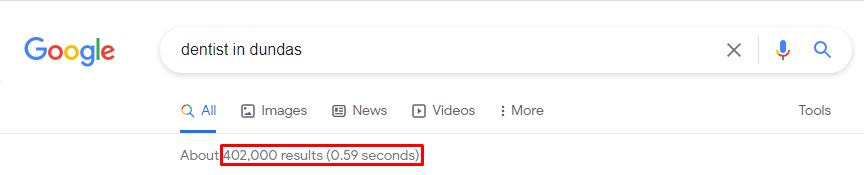
Searching on Google for “Dentist in Dundas”, we can see that there are over 402,000 pages relevant to that keyword. Google’s goal is to compare these results, determine which one is the most relevant to me, and show it at the top.

Our goal with SEO, is we’re essentially trying to convince Google that when someone is searching for “Dentist in Dundas” – our dental practice is the most relevant result, and should top all other 402,000.

Now let’s look at another example. Searching for “Invisalign in Dundas”, there are only 124,000 results.

This keyword is niched down to a specific dental service, which makes it easier to rank for because there are significantly fewer pages to compete with. And I’d rather compete with 124,000 pages and try to convince Google our page is the best, than compete with 402,000 other pages.

More importantly, people who search for “Invisalign in Dundas” are much more promising leads, since they already know exactly what they’re looking for.

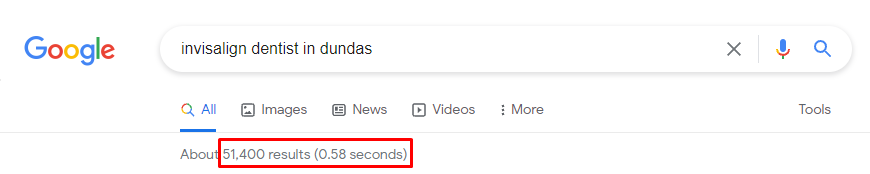
Let’s look at a third example. When we type in “Invisalign dentist in Dundas” – we get only 51,400 results.

There are much fewer pages to compete with, and I’d argue the patient behind this search is a much more qualified lead, than people who search for “Invisalign in Dundas”, or worse, “dentist in Dundas.”

As you can see, the more specific a keyword is – the fewer pages there are to compete with. In addition, the people searching for specific keywords are more likely to be a high-quality lead, ready to call your practice and set an appointment.

Dentists who are “in-the-know” aim for niche keywords. Because while a generic keyword like “Dentist in Toronto” drives more traffic than a niche keyword – there are a lot more niche keywords to target than there are generic keywords.

It’s also easier and cheaper to rank for them. So, if you rank at the top, for dozens or hundreds of niche keywords – put together you could have more traffic than from one generic keyword.

But the difference is, whether you get less, more or the same traffic – your traffic consists of more promising patients, because they know exactly what they want, and they’re searching for it.

How Do You Actually Rank for Niche Keywords?

To rank for a niche keyword, or a group of keywords – you need a dedicated page for that keyword or service. A high quality, landing page.

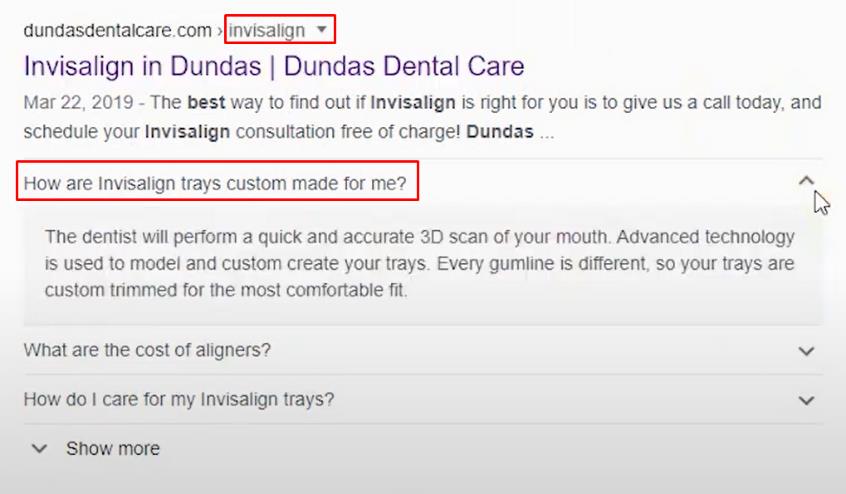
If we search for “Invisalign dentist in Dundas”, the first organic result is our website’s Invisalign landing page, not the homepage.

Moreover, because we’ve built a high-quality landing page with great content, not only does it show up at the top of Google, but Google also displays snippets of the content right on the search results page. Questions such as “How are Invisalign trays made?”, “How much do aligners cost?” and more.

So, to rank for niche keywords like “best dentist for crowns in Windsor Ontario” you’re probably going to need a landing page talking about crowns, how your dental practice is located in Windsor, and featuring great information about how you do dental crowns and what goes into that procedure.

Now targeting niche keywords, and creating high-quality landing pages for them are excellent ways to rank higher. But there’s one SEO area you can improve that will have the most impact on your rankings.

Behold, The Almighty Backlink

What are backlinks exactly? These are links from other websites pointing to your website.

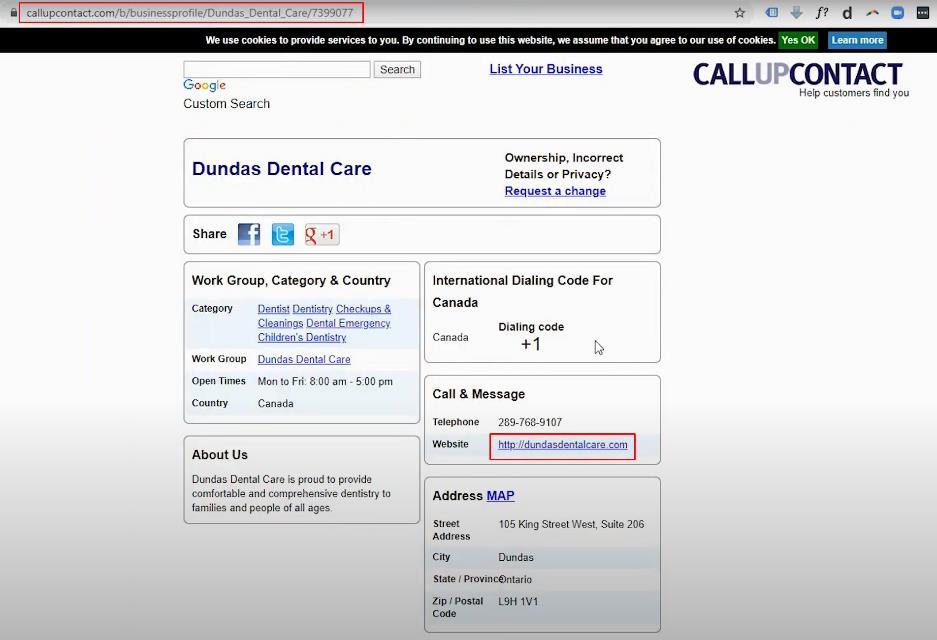
For example, directory listings like YellowPages or RateMDs that mention your business and have a link to your website.

It could be an article written about your practice that links to your website.

Or maybe you sponsor a local kids soccer team and again, they link to your website on their sponsors page. Those are all backlinks.

A higher number of backlinks tells Google that your dental practice is more popular than the competition.

For example: If you and I were competitors, and your website had 50 backlinks, while my website only had 10 backlinks – your website would show higher in the rankings.

The more backlinks your website has the more Google trusts it and the more authority it has. This is why it’s a great idea to sign up to many different directories like Bing, Yelp, Better Business Bureau, RateMDs, YellowPages, etc.

But it’s not just a numbers game. Quality matters too. You’ll want your backlinks to come from high-quality authoritative websites. Sometimes 10 backlinks from reputable websites will outrank a website with 50 backlinks coming from car repair blogs, Russian gambling websites or other low-quality, spammy places.

In fact, backlinks from spammy websites can actually lower your rankings.

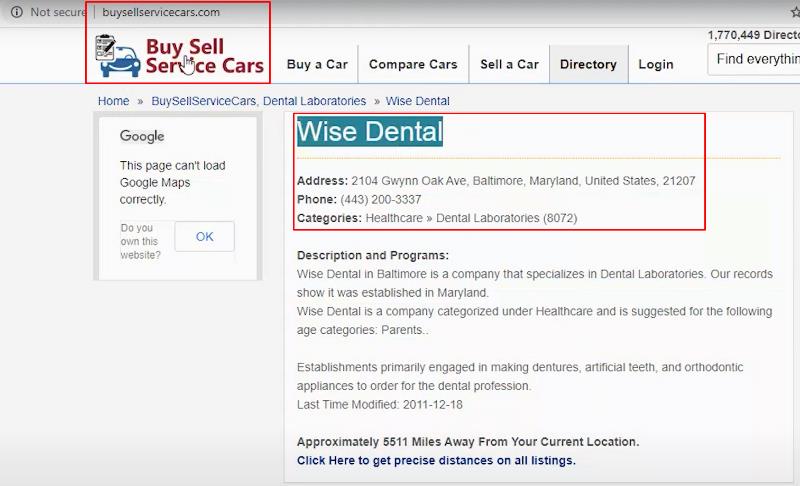
Here’s an example of negative backlinks: A dental practice called Wise Dental in Maryland has a backlink from a website about buying, selling, and servicing cars.

Now you may ask yourself… why is a dental practice listed on an automobile website?

Well, about five to ten years ago, when Google’s algorithm couldn’t make the difference between a good and a bad backlink – all backlinks were good, including the ones from fraudulent websites. The more the better. So, people jumped on the bandwagon and bought backlinks by the hundreds. These nefarious tactics were considered “SEO shortcuts” or “SEO hacks” and it used to work… but not anymore.

Those $199 a month SEO services? That’s the kind of backlinks those companies create because it’s fast and easy. The expression “you get what you pay for” is very much true in this case.

A bad case of backlinks

A while back, we had just started working with a new client from Ontario, Canada. When we started digging to find out why they aren’t ranking, we found that their practice had backlinks from a dog breeding website in Florida, a mechanic website in New Jersey, and dozens more from Russian gambling websites.

When we asked them about it – they had no idea their marketing company was dragging their practice through all this mud. Ironically – their closest competitor who did not optimize their SEO even the in the slightest – were ranking higher on Google.

It took several months (and thousands of dollars) to manually remove all the spammy links before we could lay the ground for further work.

The moral of the story is… cutting corners when it comes to SEO can backfire. And the hacks that work today can bury your website in the Google Hell tomorrow.

Good SEO takes time, costs more, and brings qualified patients. It’s common sense that you should only practice Good SEO. On the other hand, if you choose the dark side and use SEO hacks – don’t be surprised if in the end it does more harm than good.

TIP: If you’re working with a company that is doing your SEO, make sure they’re not cutting corners on your behalf, because in the end, you’re going to be the one left holding the bag.

To Sum Up…

In order to rank higher on Google, you should target niche keywords, create high-quality landing pages, and start collecting backlinks from reputable websites.

I hope this information will help your practice take its righteous place among the Google rankings. If you want to learn more about SEO and marketing for dentists, check out this blog on how to optimize your Google My Business page for better visibility.

  • « Go to Previous Page
  • Page 1
  • Page 2

Primary Sidebar

Footer

RevUp Dental

About RevUp

RevUp Dental helps dental practices attract more patients with high-converting dental websites, targeted Google Ads, and effective dental SEO strategies. Our software tracks your calls and reveals where and why your practice is losing patients. With these insights, we train your front desk team to confidently book more patients.

  • tiktok Icon

Contact Us

Want to know more about what we can do for you and your practice? Reach out to us. We’d love to have a one-on-one conversation with you to see if we’re the best fit for your needs.

  • 1-866-530-2544
  • info@revupdental.com
  • 33 Main St W, Grimsby, ON L3M 1R3, Canada
RevUp Dental © 2026 Rights Reserved | Privacy Policy